

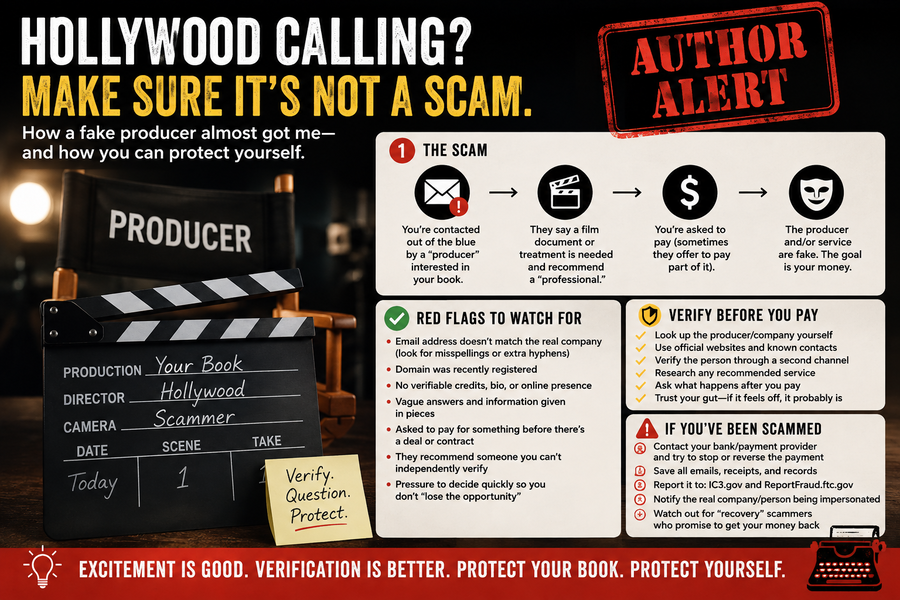
A few days ago, I received a message through the contact form on my website from film producer Jeffrey Silver of Biscayne Pictures.
Or so I thought.
He had discovered Dogs of Dreamtime and was interested in its potential as a film. His emails were thoughtful and flattering. He clearly knew enough about the book to make the interest sound credible.
And Jeffrey Silver is a real producer with an impressive list of credits.
So we began talking.
Then things got strange.
How the scam worked
After several emails, “Jeffrey” told me the project needed a roughly 20-page creative film document. He recommended someone named Xenia A. Schneider to develop it and generously offered to pay half the cost.
I contacted Xenia.
She sent me to a website offering three tiers of services for $450, $750 and $900. But when I asked which tier corresponded to the document Jeffrey wanted, I couldn’t get a straight answer. She wanted me to choose a tier first.
That made no sense.
I looked for information about her. I couldn’t find professional credits, a LinkedIn profile, photographs, previous projects or any meaningful independent online presence.
That made even less sense.
Still, we’re talking about a few hundred dollars. I could easily have paid it.
And I suspect that’s precisely the point.
The amount was small enough that an author excited about possible film interest might simply think, Why risk losing this opportunity over $300 or $400?
I didn’t pay.
Instead, I started asking “Jeffrey” increasingly direct questions. If I paid to have this document created, did that mean he would option the book? What exactly happened next? Why was I being asked to help finance development materials he required?
The answers continued to come in pieces.
Finally, I looked more closely at his email address.
He was writing from:
The legitimate company website is:
biscaynepictures.com
One tiny hyphen.
I checked the domain registration.
The hyphenated domain had been registered the previous month.
There was no Jeffrey Silver.
At least, there was no Jeffrey Silver talking to me.
Then another Hollywood producer found me
The next day, another message arrived through my website.
This time it was supposedly Kristie Macosko Krieger, Film & Television Producer at Amblin Entertainment.
Kristie Macosko Krieger is also a real person. She is a major Hollywood producer who has worked extensively with Steven Spielberg.
Her supposed email address?
kristiemacoskokrieger.producer@gmail.com
At that point, any lingering question about what had happened disappeared.
Someone appears to be targeting authors by impersonating legitimate film producers.
And it’s a clever scam.
Why authors are particularly vulnerable
Every author knows how unlikely it is for Hollywood to come calling.
Which is exactly why, when it happens, you want to believe it.
Someone has rediscovered the book you wrote years ago. A successful producer sees something in it. Maybe the book is about to have an entirely unexpected second life.
The scammer doesn’t need to promise you millions of dollars.
He needs to get you excited.
Then comes the small hurdle.
A treatment. A pitch deck. A creative film document. A screenplay analysis. Some other professional material that supposedly needs to be prepared before things can move forward.
And conveniently, the producer knows just the person to do it.
In my case, he even offered to pay half.
That was a particularly smart touch. It made us seem like partners investing in the project together.
Except I had no evidence that he was paying anyone anything.
I was the person being asked to send money.
How to spot this scam before you pay
The biggest lesson from my experience is simple:
Verify the person independently before you get emotionally invested in the opportunity.
The FTC gives the same basic advice about impersonation scams: when someone unexpectedly contacts you claiming to represent a person or organization, verify the contact using information you find independently. Don’t rely on the phone number, email address or links the person contacting you provides. (Consumer Advice)
If a producer, agent, publisher or other industry professional unexpectedly contacts you:
Look carefully at the email address. Don’t glance at it. Read every character. biscayne-pictures.com looked perfectly reasonable until I compared it with biscaynepictures.com.
Look up the real person independently. Find the producer’s production company, agency or studio yourself. Don’t use links in the email.
Check the domain. A domain supposedly belonging to an established production company that was registered three weeks ago deserves an immediate explanation.
Verify through a second channel. Contact the real production company using contact information you find yourself and ask whether the person contacted you.
Research anyone you’re being asked to hire. Credits should be verifiable somewhere other than the person’s own website.
Be especially cautious when the opportunity requires you to spend money. Once the conversation moves from “I want your book” to “I need you to buy this service,” stop and investigate.
Ask what happens after you pay. Does the producer intend to option the property? Is this simply material needed to decide whether they’re interested? Are there additional paid steps coming?
Pay attention to information arriving in breadcrumbs. I kept being given enough information to take the next step without ever being shown the whole road. In retrospect, that was one of the biggest warning signs.
And don’t assume sophistication proves legitimacy. A scammer can research your book, your website and the producer they’re impersonating before contacting you. An email containing accurate details about your work proves that somebody did their homework.
It doesn’t prove who they are.
If you’ve already paid
Act quickly.
Contact the bank, credit-card company, payment app or other company you used to make the payment. Tell them the transaction was fraudulent and ask whether it can be stopped, reversed or disputed. The FTC recommends doing this regardless of how you paid because recovery may still be possible. (Consumer Advice)
Then preserve everything: emails, complete email headers, receipts, payment information, websites, screenshots, domain information and correspondence. The FBI specifically recommends retaining communications and financial records associated with suspected fraud. (Internet Crime Complaint Center)
Report the incident to both:
FBI Internet Crime Complaint Center (IC3)
You can report an attempted scam even if you caught it before losing money. The FTC specifically encourages people who spot fraud to report it because reports can help authorities identify patterns affecting other victims. (Federal Trade Commission)
If someone was impersonating a real producer, agent, publisher or company, notify the real person or company as well. They have an interest in knowing that their name is being used to defraud people.
There’s one more warning worth knowing. People who have already lost money are sometimes targeted again by “recovery” scammers who promise to get the money back for an upfront fee. The FTC issued a warning about this just last month. (Consumer Advice)
The part that almost worked on me
It wasn’t the money.
It was the story.
A successful producer had found a book I wrote years ago and saw something in it that might translate beautifully to film.
That’s a pretty good story to tell an author.
Fortunately, the business side of my brain kept interrupting the author side of my brain with one annoying question:
Why doesn’t any of this quite add up?
Eventually, I stopped trying to make it add up and started checking whether it was real.
It wasn’t.
So if Hollywood unexpectedly comes knocking on your door, enjoy the moment.
Then check the email address.
Related Posts: